[Previous] [Next] [Up] [Top] [Index]
Robert Hamerling
(1830-1889)
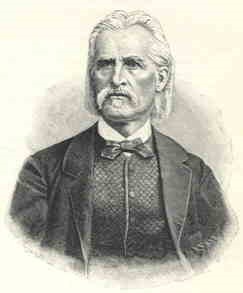
| |
The Austrian poet-philosopher was born March 24, 1830. Early on he
showed an ability in poetry, and although from poor parentage, the
generosity of friends led him to attend the gymnasium in Vienna,
and afterward the University there. In the revolutionary movements
which swept Europe in 1848, Hamerling joined the student legion in the
Vienna revolt. The collapse of the uprising in 1849 made it necessary
for him to hide for a long time in order to escape arrest. Later he
studied natural science and philosophy. In 1855 he was appointed
master at the gymnasium in Trieste. Many years of ill health caused
him finally to retire on a government pension in 1866. In comparatively
comfortable circumstances, Hamerling spent the remainder of his life
in his home near Graz, devoting himself to writing until his death
on July 13, 1889. He is referred to as “one of the most remarkable
poets of the Austrian school; his poems are full of life and color.”
His most popular work was
Ahasver in Rom,
Ahasver in Rome (1866), with Nero as principal character.
Der Konig von Sion, The King of Zion, (1869) is generally
considered to be his masterpiece. In 1888 his
Homunculus
appeared, and was reviewed with extensive comment by Rudolf Steiner. His
Amor und Psyche
was published in 1882; his novel
Aspasia
(1876), described Greek life in the age of Pericles. In 1870 his drama
concerning the French Revolution,
Danton und Robespierre,
was published. Rudolf Steiner commented on this drama in his Speech and
Drama Course given in 1924, and in fact, many references to Hamerling and
his work appear in books and lectures by Rudolf Steiner, including the
latter's autobiography.
[Previous] [Next] [Up] [Top] [Index]
|
|

|
![[e.Lib Logo]](/icons/pix/elib_icon5.gif)
![[e.Lib Version Info]](/icons/pix/elib_bios.gif)
![[e.Lib Name]](/icons/pix/elib_long.gif)
![[Spacing]](/AIcons/images/space_72.gif)


![[Project Gutenberg Mirror Link]](/gutenberg/images/PG_104x104DEF.gif)